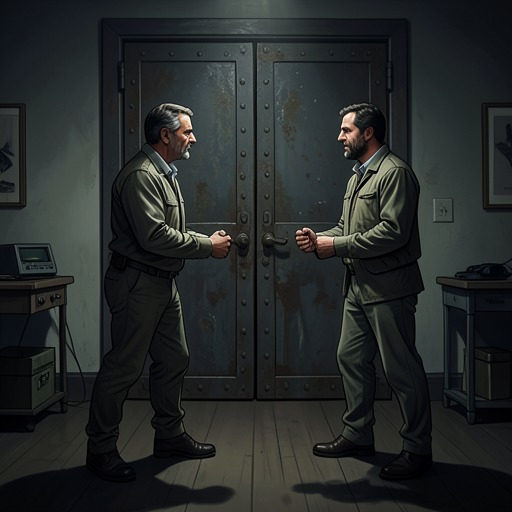
Barrera–Méndez cartel war
The Power of the DogThe Barrera–Méndez cartel war is a contest between Don Adán Barrera’s organization and Güero Méndez that turns control of drug distribution into a test of political reach and collective survival. Its stakes extend beyond territory: the conflict reshapes dealer loyalties, draws family members into retaliation, and unfolds within a system where cartel protection and government authority are difficult to separate.
A federation built on protection
The war takes shape within the wider structure Don Adán is building around the Federación. In a discussion with García Abrego, Don Adán describes Guadalajara as a safe base from which to serve the organization. He presents the arrangement as an exchange: allies will share his protection, while those receiving it will pay a fee. The scene makes protection more than a private favor. It is a means of organizing territory and relationships across the drug trade, and it helps explain why a conflict between rival groups can threaten the larger network.
That structure depends on more than coercion. Don Adán’s claim to leadership rests on positioning and practical alliances, not simply on a formal title. A war over a local plaza therefore tests whether his promises of shared protection can hold when rivals challenge the organization’s reach. The arrangement also makes political connections consequential: if a rival can move product through a route the Barreras have restricted, or gain support from officials, the dispute cannot be resolved by controlling dealers alone.
The organization’s political leverage is established in other parts of the story. The Federación helped the Institutional Revolutionary Party retain power in the 1988 election after the vote-counting computers malfunctioned. Later, on the day a new president took office, brokerage houses controlled by the organization bought government bonds before cartel capital was withdrawn from the national bank and the peso was devalued. The Federación profited from the resulting economic reversal and returned its money in exchange for a favorable environment for its business. These episodes do not begin the war, but they show the political and financial scale against which Güero Méndez’s challenge is measured.
The decision to go to war
The immediate decision arrives after months of preparation. Don Adán returns to Tijuana, tells Raúl Barrera that the deal is settled, and the narrative marks the moment as the point when the coming conflict can begin. Raúl sees the timing as favorable. The arrangement has taken months to complete, but the brothers now believe they are ready to confront Güero Méndez.
The war is also connected to a commercial shift. Don Adán’s deal with the Orejuela brothers gives the Barreras a steady supply of product from the Cali Drug Cartel. The narrative links that supply to their ability to assemble the men and money needed for the fight. In this account, an alliance made beyond the immediate battleground changes the balance within it: the Barreras’ access to cocaine becomes a source of resources with which to contest Güero Méndez’s influence.
The contest is presented as a forced choice for local dealers. Raúl demands that they align with one side or the other, using the familiar divide between Coke and Pepsi to make the rule plain: a dealer cannot distribute for both. The consumer-brand comparison gives the choice a surface of ordinary business, but the consequences are not ordinary. Allegiance is made legible, and a refusal to choose is not offered as a safe alternative.
Retaliation and the cost to families
The war’s most consequential escalation is Bloody September. The Barreras kill Güero Méndez’s wife and children; the account also notes that evidence of the deaths is sent to him. Adán recognizes that the Barreras have made the first move against families. His reflection marks a shift in responsibility: Méndez did not establish this practice; the Barreras did.
The response is treated as both shocking and, within the drug world, anticipated. The local police barely investigate the killings. People familiar with the trade regard Méndez’s retaliation against Barrera family members as an expected consequence of the earlier murders. That expectation reveals the war’s governing logic: once relatives are used as targets, further retaliation is understood as the likely next step rather than an exceptional breach. The conflict has crossed from competition between organizations into a cycle that draws family ties into its calculations.
The narrative places this knowledge beside the ordinary demands of Don Adán’s day. After visiting graves in Mexico City, he flies to Guadalajara to attend to his responsibilities and then continues to Puerto Vallarta, where Raúl is at a party. Raúl’s reminder that it is the Day of the Dead sits against the news of family killings and graves. The contrast does not soften the violence; it shows how the war continues amid ceremonies, business, and social life, without granting its participants a separate world in which to contain it.
Dealers, routes, and public signals
The war also reaches into San Diego’s dealer network. Two dealers are found dead in separate locations, one in a car off a dirt street in San Ysidro and another in a motel room. The narrative connects their deaths to the choice between the rival camps: one had declared loyalty to Güero Méndez. Pepsi cans left in the victims’ mouths confuse American police, who do not understand the cartel’s brand-based signal. The detail turns an apparently familiar object into a marker of allegiance and a message about the cost of choosing sides.
The battle for the plaza is described as bloody but simple in its terms: dealers must choose one organization. Yet the simplicity is misleading. Allegiance depends on who can supply product, offer protection, and enforce a decision. By making commercial loyalty visible, the Barreras convert the retail network into a map of the conflict; the dead become evidence of the price of that division, while the police’s confusion shows how much of the war’s meaning remains coded for outsiders.
An unstable balance of power
A later attack on La Sirena makes Don Adán question whether the balance has shifted. He is recovering from an injury when he considers the attack’s use of federal uniforms and identification, which would have required substantial bribery. The fact that Güero Méndez was willing to violate the prohibition on violence in a resort town suggests to Don Adán that Méndez’s business is stronger than the Barreras had assumed. Don Adán wonders how Méndez is moving product through the plaza the Barreras have largely closed to him, and whether he has secured support in Mexico City and among federal officials.
These questions widen the conflict beyond the dealers who are openly forced to choose. If Méndez has political backing, the Barreras’ control of routes may not be enough to contain him. The episode makes institutional access another disputed resource: uniforms and identification can be used to stage an operation, while the apparent involvement of officials raises the possibility that the cartel’s rival has support beyond its own organization.
The war’s wider aftermath is framed by the Federación’s later return to power, with Don Adán as its leader. The organization profits from the peso crisis and secures a favorable environment in which to resume business. This does not mean the conflict is reducible to a single battle or that the political settlement erases its costs. Rather, the war demonstrates how local violence and national influence reinforce one another: commercial supply finances the struggle, forced loyalties organize the market, retaliation reaches families, and political leverage helps determine which organization can operate. Its defining contradiction is that the drug trade presents itself as a system of protection while repeatedly making protection conditional, contested, and insufficient.